

Skip to content

Rooftop electrical tripod replacement

Your roofer won’t touch the wires crossing your roof. The tripod is a job for a master electrician, ideally before the new roof goes on.

Régie du bâtiment du Québec
RBQ licence
5855-0849-01
Corporation des maîtres électriciens du Québec
CMEQ member
17468
Our service

The electrical tripod: the support that carries wires across your flat roof

We replace electrical tripods on flat roofs in Verdun and the Southwest of Montreal. The roof tripod is the support that holds the building’s supply wires above the roof.

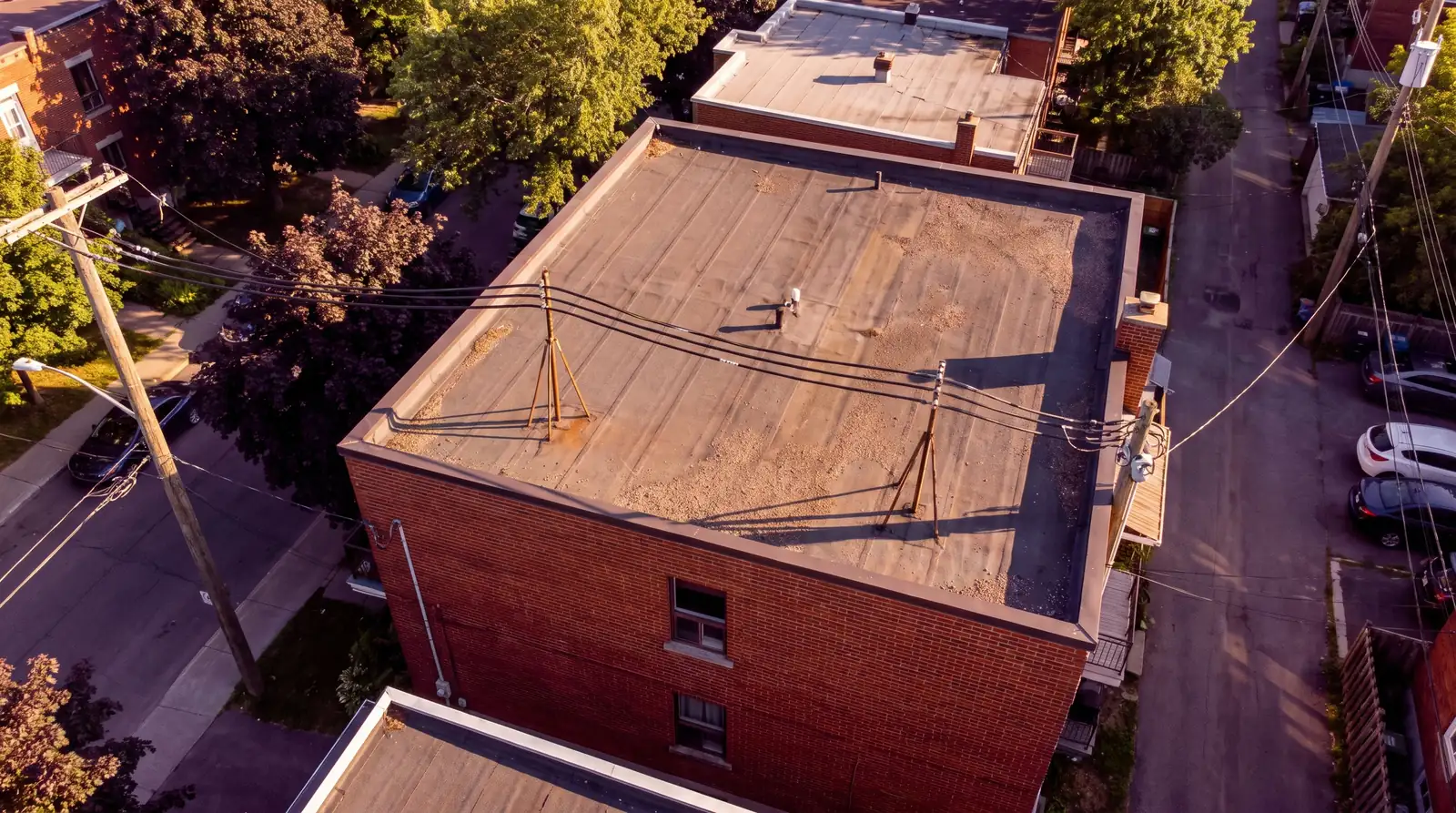
On many buildings, the service arrives on one side, street or yard, and the panels are on the other. To cover that distance, a cable called a triplex crosses the roof, open to the air, with no conduit. The tripods hold it up from one end to the other.

Marc-André sees them on flat roofs on the island of Montreal. “Elsewhere, there aren’t really any,” he says. In the buildings of Verdun and Ville-Émard, “most still have them today,” he wrote to us.

Replacing a tripod isn’t mandatory in itself. The question comes up when work has to be done on it, such as for a new roof, or when voltage drops keep coming back in the units. Those drops can come from Hydro-Québec’s grid as well as from the building’s wiring: we look for the cause first.

When our work touches a tripod’s circuit, we have to replace it completely rather than repair part of it. Two routes are then possible, described further down: conduit on the roof or new supports.

  • We assess the tripod, the cable and the panels on site
  • We look for the cause before proposing any work
  • We plan the electrical before the roof is redone
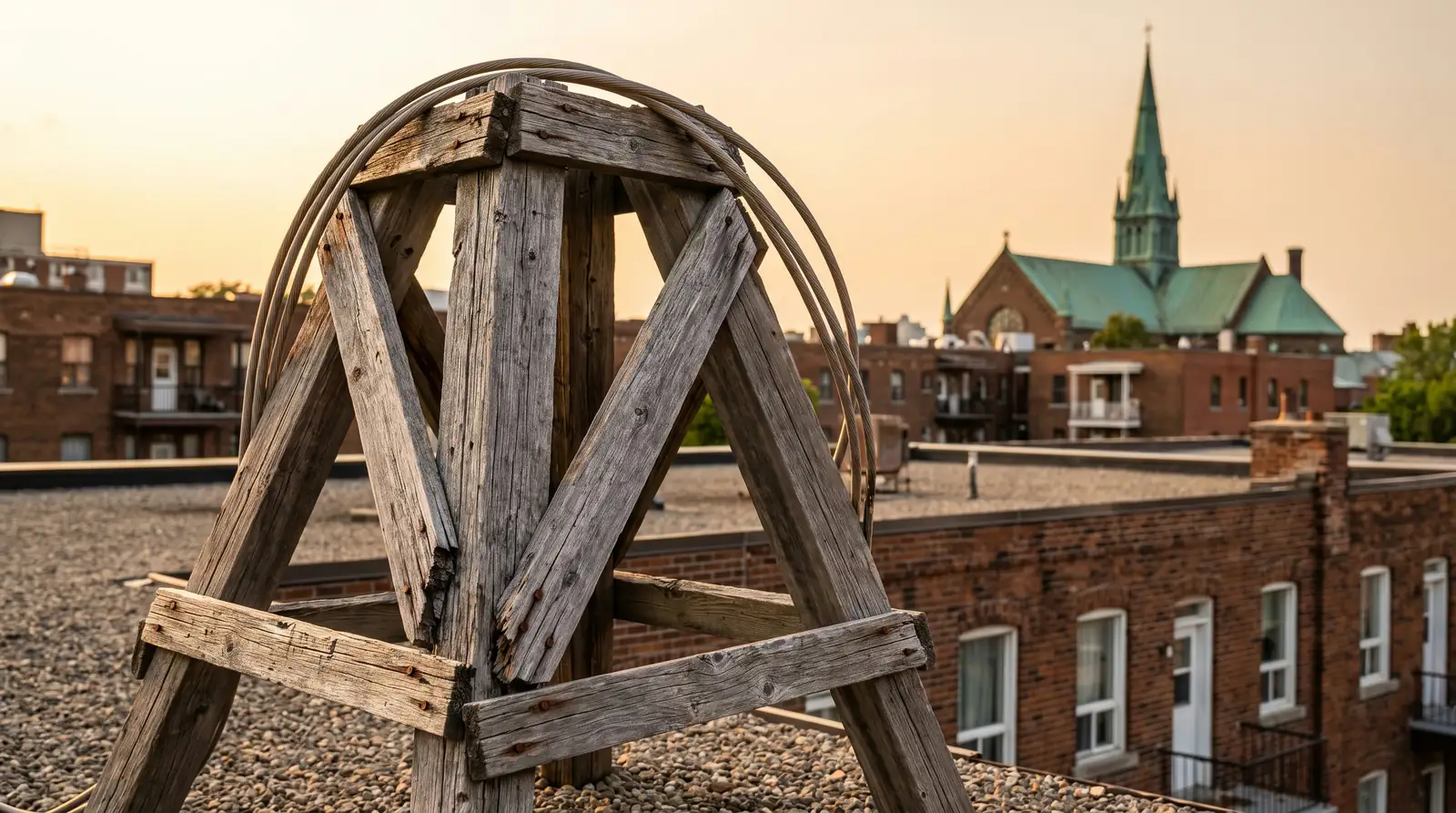
Old tripod made of grey, split pieces of wood nailed together, on a gravel flat roof, with a coiled cable over it

How it works

From the flat roof to finished work

  1. You text us

    At (514) 929-9963, with the address and your roofer’s planned date.

  2. Marc-André goes up on the roof

    He assesses the tripods, the cable, the service and the panels.

  3. We explain the option before the bill

    You know what we recommend, and why, before you sign anything.

  4. We do the work and guarantee it

    We plan it with you and your roofer, Monday to Friday. The work is guaranteed for one year, parts and labour (labour only if you supply the equipment).

Start your project
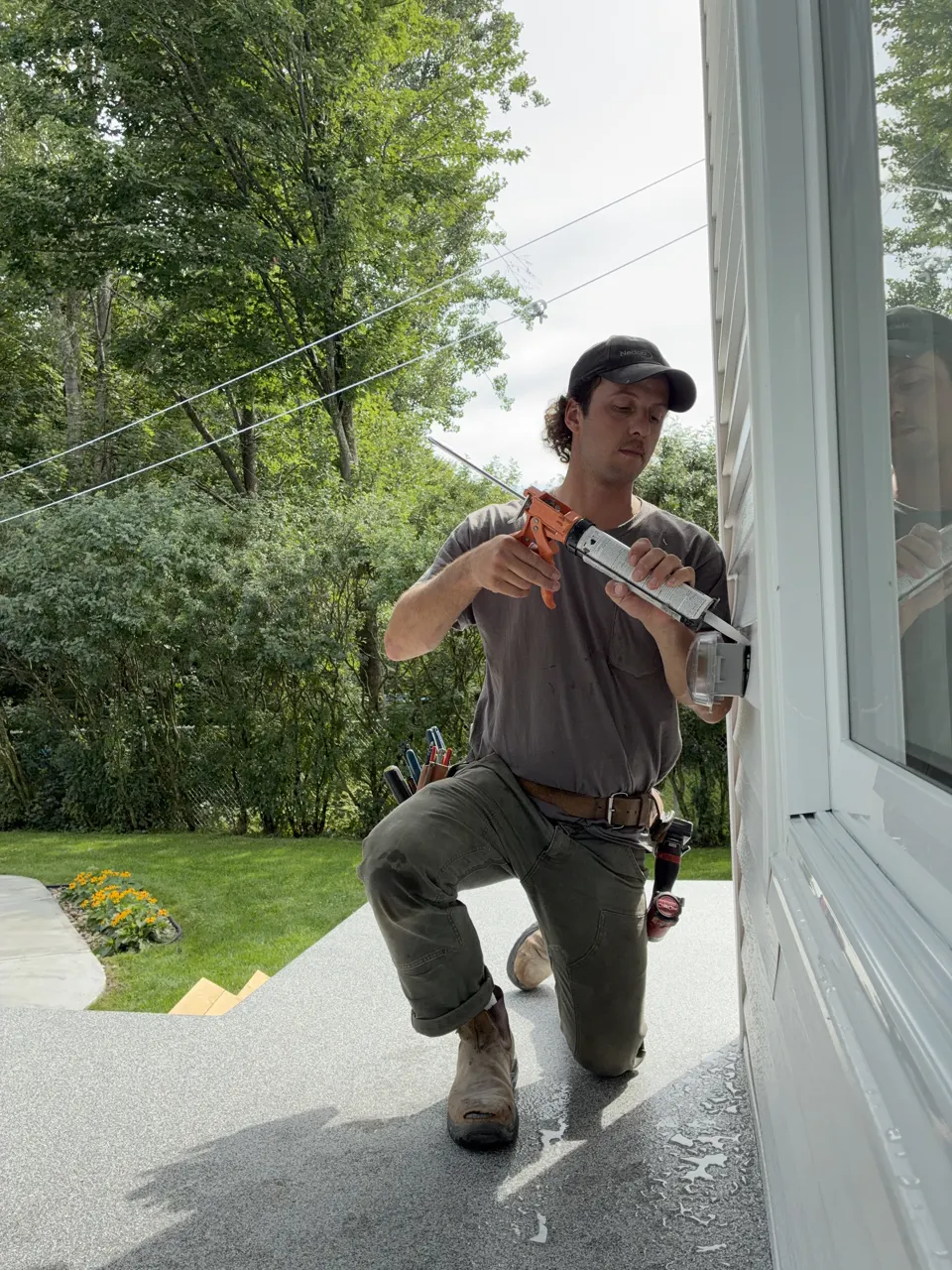
Marc-André Vinet, master electrician, sealing an electrical box on an exterior wall
Assessment

Signs your electrical
tripod needs replacing

Even without a new roof, some tripods show they have done their time. Look at them from the ground: don’t go up on the roof and don’t get near the wires, which are live.

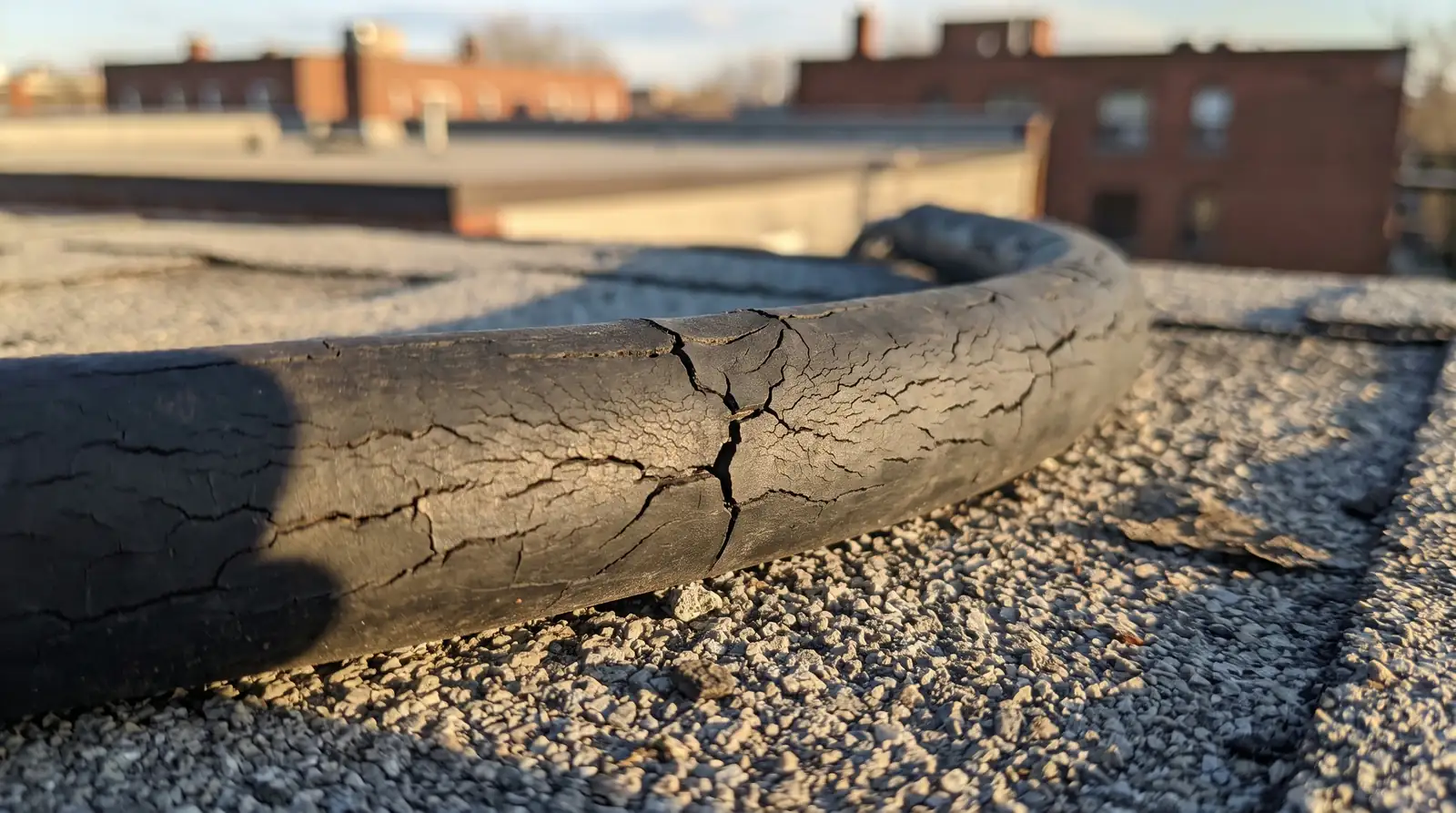
  • A cracked jacket

    The cable dries out in the sun, the jacket breaks and leaves the wire poorly protected. That is a risk of electrocution, for you and for the roofer.

  • A wooden tripod

    Some are still two pieces of wood nailed together.

  • Hand-twisted metal cables

    Some tripods are held up only by metal cables twisted by hand to keep the line from swinging in the wind.

  • Power that keeps dropping

    Voltage drops or outages that keep coming back can come from the grid as well as from worn wires and outdated connections. Hydro-Québec asks you to call its outage line first; if the cause is in the wiring, we track it down before proposing any work.

Start your project
Close-up of a cable whose black jacket is cracked all over, lying on a gravel flat roof
Scope of the work

What changes the scope of a tripod replacement

Two neighbouring flat roofs don’t call for the same job. These five things show up on the roof, not over the phone.

  1. The size of the roof

    The longer the roof, the longer the cable to support or protect.

  2. The number of tripods

    Every support along the route is part of the job.

  3. The distance between the service and the panels

    It sets the full route of the cable across the roof.

  4. The condition of the connections

    Outdated connections along the route show up during the visit, and they count in the work to be done.

  5. The option chosen

    Conduit on blocks and new supports don’t call for the same work.

A new-tripod job starts at $6,000. The number of supports makes the difference: count on about $1,500 per tripod. It is a ballpark figure, not a quote: the amount is confirmed on the roof.
Two solutions

Replacing a tripod: conduit on the roof or new supports

When a tripod has to be replaced, two options are possible. The choice depends on the roof and on what Hydro-Québec’s rules allow.

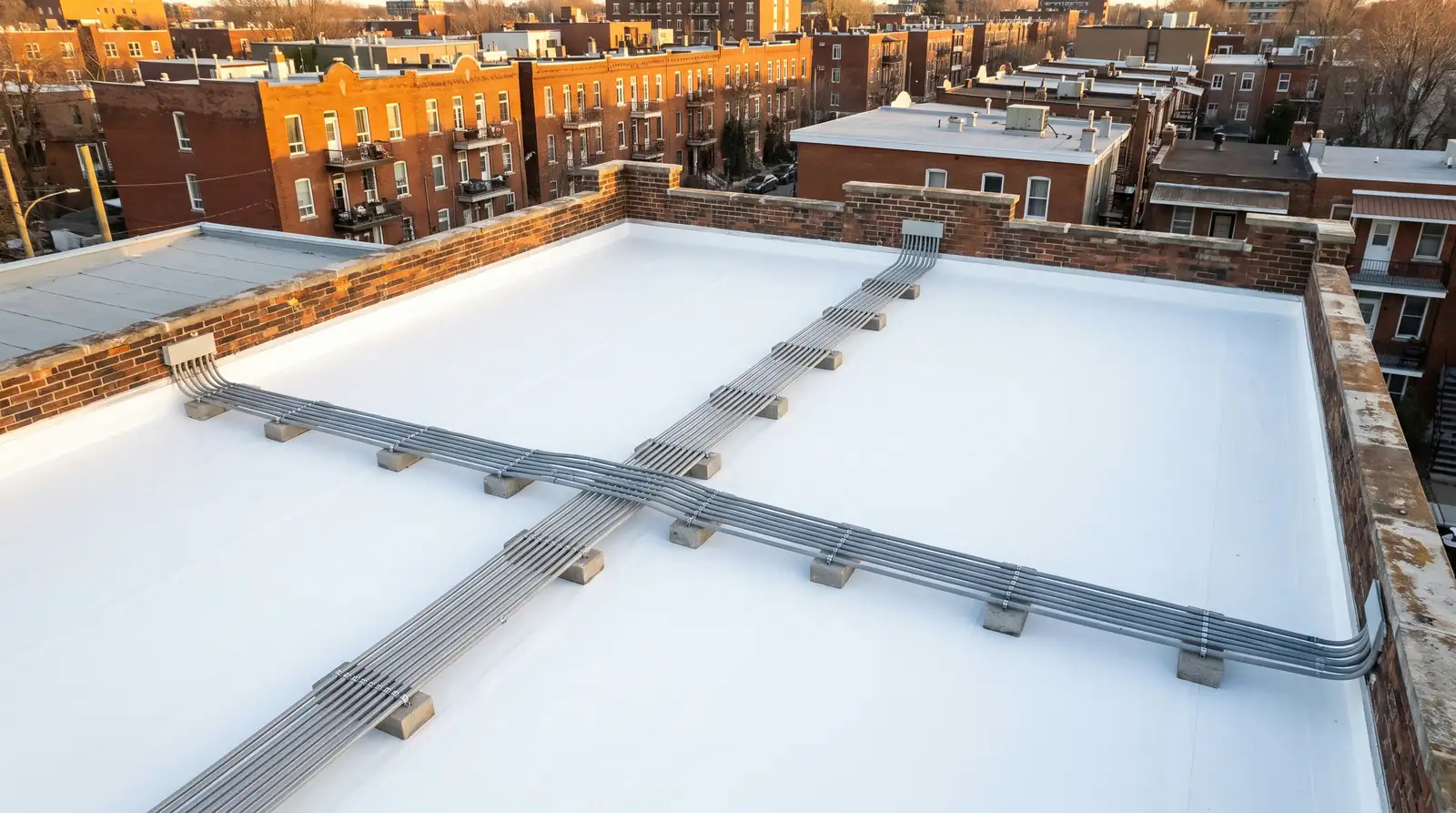
Conduit laid on the roof, on blocks

The cables run through conduit laid flat on the roof, on concrete or wood blocks. They are no longer open to the air. Depending on the case, Marc-André considers it the most economical and practical solution.

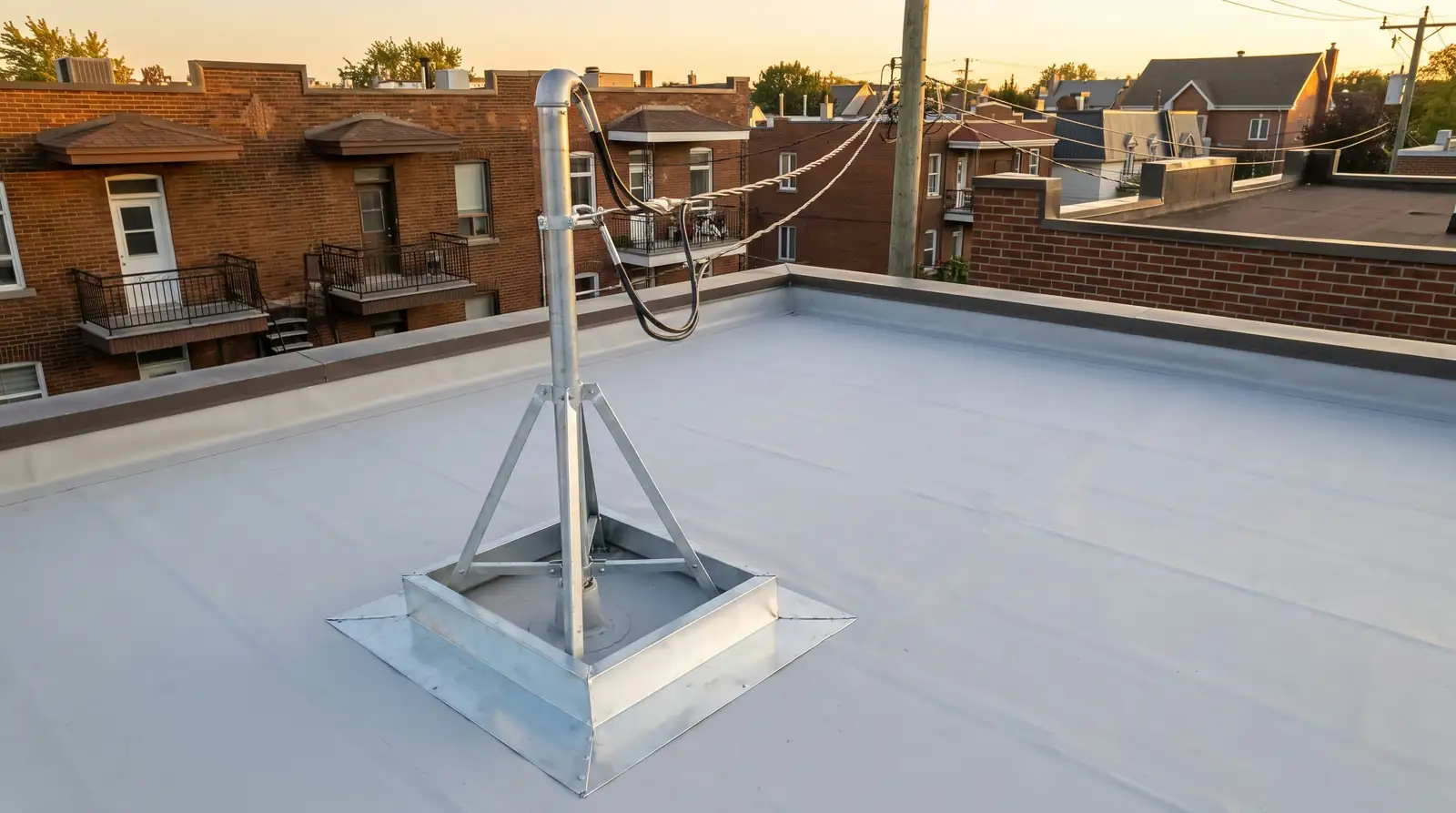
New supports, where allowed

The cable stays overhead, on new supports, with secure connection points. This option depends on what each support carries, starting with the one that receives Hydro-Québec’s line.

Hydro-Québec’s service standard (E.21-10) defines a chevalet as a metal support fitted with insulators and installed on the roof of a building. For an existing chevalet, the location of the connection point depends in particular on its height and on the clearances set by Hydro-Québec (standard E.21-10, section 2.4.3.1).

A Hydro-Québec good-practice guide states that chevalets may no longer be used, but that an existing one can be kept under an acquired right. The support that receives Hydro-Québec’s line is therefore not handled like the ones that hold the cable further along the roof. Replacing it is the building owner’s responsibility, following Hydro-Québec’s standards, and the power cut goes through Hydro-Québec before the work.

We look at your roof, the cable route and what your roofer plans to do. We check what each support carries before proposing an option.

Not the same job

Tripod or service entrance: what the replacement changes

The two follow each other along the same route, and they are often confused.

  1. The tripod

    It holds up the conductors on the roof, from one support to the next.

  2. The service entrance

    It runs from the connection point to the service box, including the service head and the wires between its parts. That is the definition used by the Office québécois de la langue française.

  3. The roof

    That belongs to your roofer. We sort out the electrical so they can work on a clear roof.

Replacing a tripod doesn’t change the capacity of your service. If you plan to add an appliance, the load calculation tells whether the service is enough.

In Verdun, Marc-André still sees many pre-war plexes on a 100-amp service. We assess the available capacity before recommending an upgrade.

Before you call the roofer

What helps us prepare the roof visit

Everything can be noted from the ground, without going near the wires, even for a photo.

  1. The building’s address

    And the number of units it supplies.

  2. Photos you already have

    Or taken from the ground or a window, without leaning toward the wires.

  3. The service side

    Note whether it comes in from the street or the yard, and where the panels are.

  4. Power drops

    Note whether any units have voltage drops or outages that keep coming back, and whether you have already called Hydro-Québec.

  5. The roofer’s date

    Text it all to (514) 929-9963, with the planned date of the roof job.

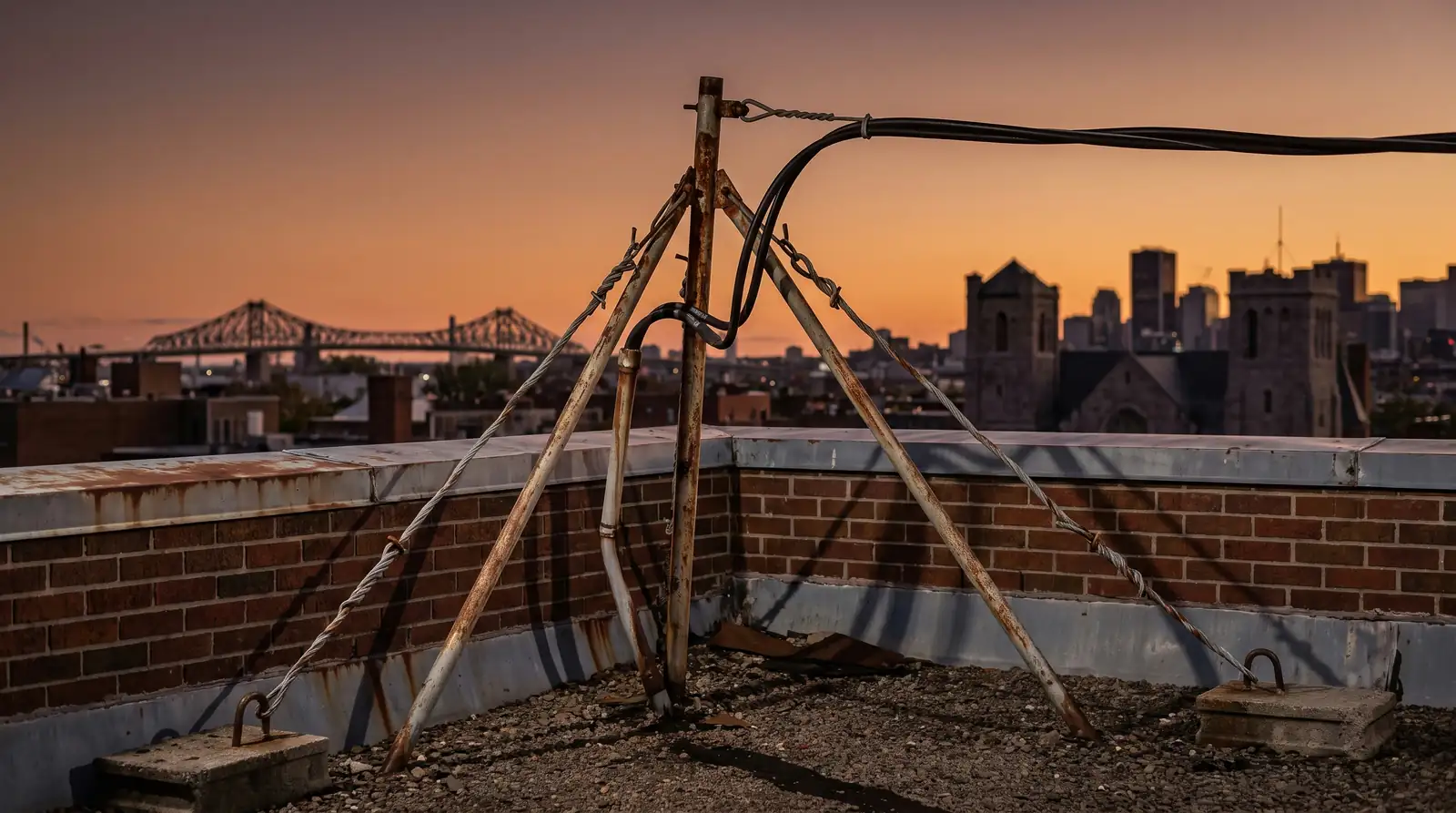
Rusted metal tripod on a flat roof, held by twisted steel cables anchored to concrete blocks, with the supply cable tied at the top
5,020 avis
Google
10 years

In the trade for Marc-André

About ten years in the trade, and the habit of going up to see the roof before proposing anything.

2,000+

Projects completed over his career, residential and light commercial

180

Projects a year, assessed by Marc-André

1 year

Warranty on parts and labour

Why you can trust us

A tripod carries the power for the whole building

Marc-André Vinet, master electrician, has replaced and repaired tripods on flat roofs.

Marc-André is the one who climbs onto the roof to assess it. RBQ 5855-0849-01, CMEQ member 17468.

What people say about us
  • Charles Tremblay-RoyGoogle review★★★★★

    « Service impeccable ! L'électricien a été ponctuel, professionnel et a fait un travail de grande qualité. Tout fonctionne parfaitement. Je recommande sans hésitation ! »

  • Isabelle GervaisGoogle review★★★★★

    « J'ai fait affaire avec cette entreprise quelques fois et je recommande fortement. Service super professionnel, et le travail est impeccable. »

  • Etienne Gauvreau-HurtubiseGoogle review★★★★★

    « Véritable allié stratégique pour nos projets d'électricité, Marc-André est efficace, courtois et rapide. Nous le recommandons! »

  • joel touchetteGoogle review★★★★★

    « Service professionnel, offre des options pour ne pas augmenter le prix inutilement concernant le choix des travaux à réaliser »

  • Charles Tremblay-RoyGoogle review★★★★★

    « Service impeccable ! L'électricien a été ponctuel, professionnel et a fait un travail de grande qualité. Tout fonctionne parfaitement. Je recommande sans hésitation ! »

  • Etienne Gauvreau-HurtubiseGoogle review★★★★★

    « Véritable allié stratégique pour nos projets d'électricité, Marc-André est efficace, courtois et rapide. Nous le recommandons! »

  • Isabelle GervaisGoogle review★★★★★

    « J'ai fait affaire avec cette entreprise quelques fois et je recommande fortement. Service super professionnel, et le travail est impeccable. »

  • joel touchetteGoogle review★★★★★

    « Service professionnel, offre des options pour ne pas augmenter le prix inutilement concernant le choix des travaux à réaliser »

1 / 4
Price estimator

A rough idea of
your project cost

The estimator doesn’t cover the tripod: that is assessed on the roof. If your project also involves the panel, it gives you a quick, non-binding estimate, never a quote.

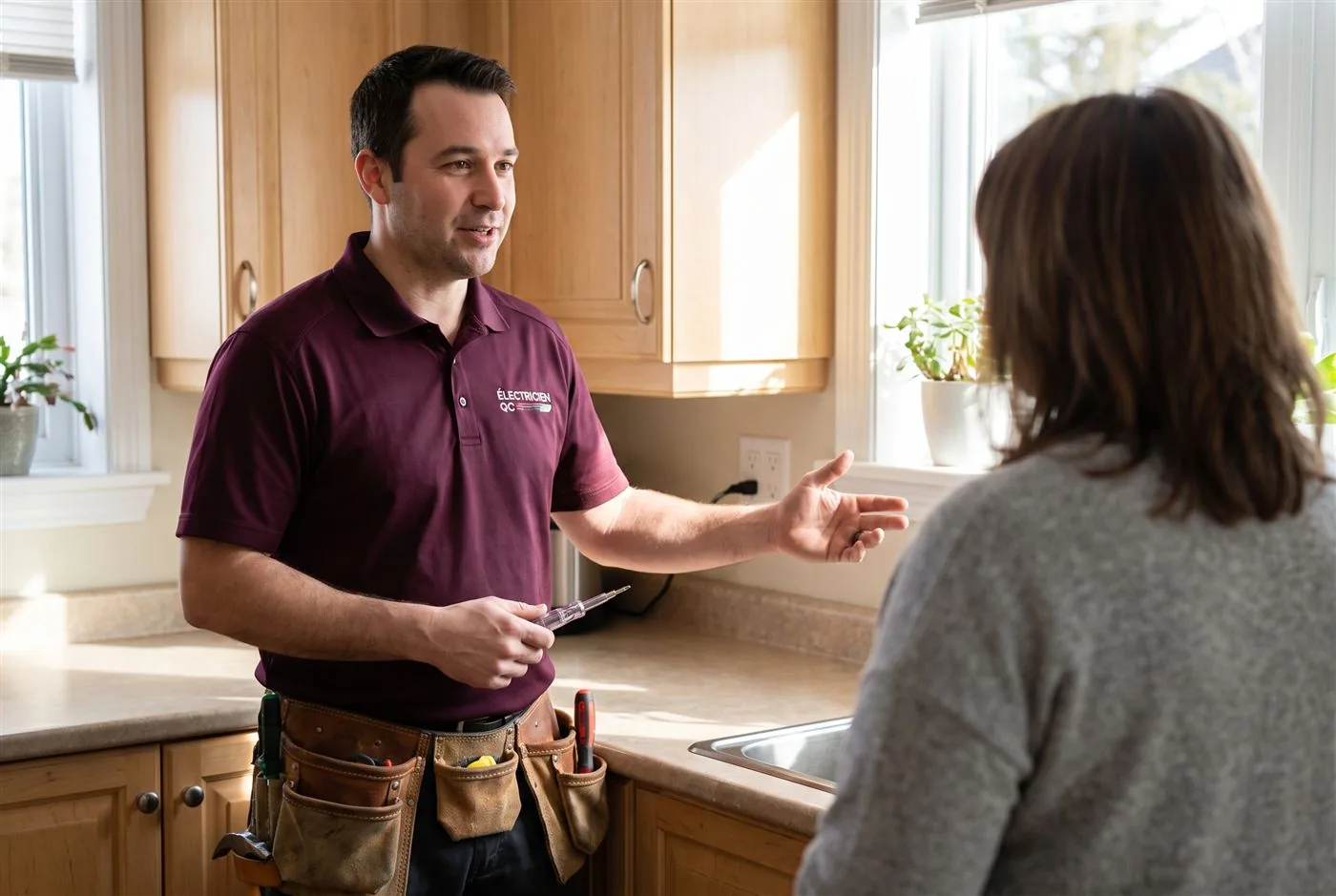
Électricien qui répond aux questions d’une cliente avant les travaux

Your questions

Frequently asked questions

Nothing here promises a timeline or an amount: for that, we need to see the job.

No, not in itself. The question comes up when work has to be done on the tripod, for example for a new roof, or when the power drops or cuts out repeatedly. In that last case, call Hydro-Québec first: the cause can be the grid or the wiring, and the work depends on the diagnosis.

No. When our work touches a tripod’s circuit, we have to replace it completely. We assess the condition of the cable and supports before recommending the work.

Ideally the electrician, before the roof job: the roofer doesn’t touch supply wires. If the roof is redone first, it is not ideal, but we can replace the tripod afterwards.

The wood isn’t the only issue. A jacket cracked by the sun leaves the wire poorly protected, with a risk of electrocution. We assess the tripod and the cable on site before telling you what to do.

No. The tripod holds up the conductors on the roof. Capacity depends on the service and the panel, and the load calculation tells whether it is enough. If you have doubts, tell us at the visit: we look at the service too.

Service area

Where we install

Verdun, Ville-Émard, Côte-Saint-Paul, LaSalle, Lachine, and the rest of Montreal’s Southwest and the South Shore. Not sure you are in the area? A text message at (514) 929-9963 does the job.

Start your project

Tell us about your project

Describe it in a few words, even if it is still just an idea. We assess on site what your installation can take, and you decide from there.

(514) 929-9963

Start your project

A photo of your panel or of the spot often saves us a back and forth.

Thank you! Your request is on its way. Marc-André gets back to you as soon as he can.

CallStart your project